What Is Your “Net” Worth? The Ledger of a Fisher of Men
We live in an age of ever-increasing numbers of millionaires and billionaires, people whose standing is measured precisely by a financial net worth; there is talk now of the first trillionaire. It is worth remembering Simon Peter, his brother Andrew, and their partners James and John. They had toiled all night and taken nothing. Then, at a word, they let down the nets again and enclosed so great a multitude of fishes that the nets began to break and both boats began to sink (Luke 5:4–7). For one morning, their net worth in the plainest sense was the largest it had ever been.
And it was to men like these that Jesus extended the invitation to become fishers of men — completely upending traditional accounting. Matthew puts the words first to Simon Peter and his brother Andrew, caught in the middle of a cast; James and John were called a few steps further down the shore, and left the boat with their father still in it.
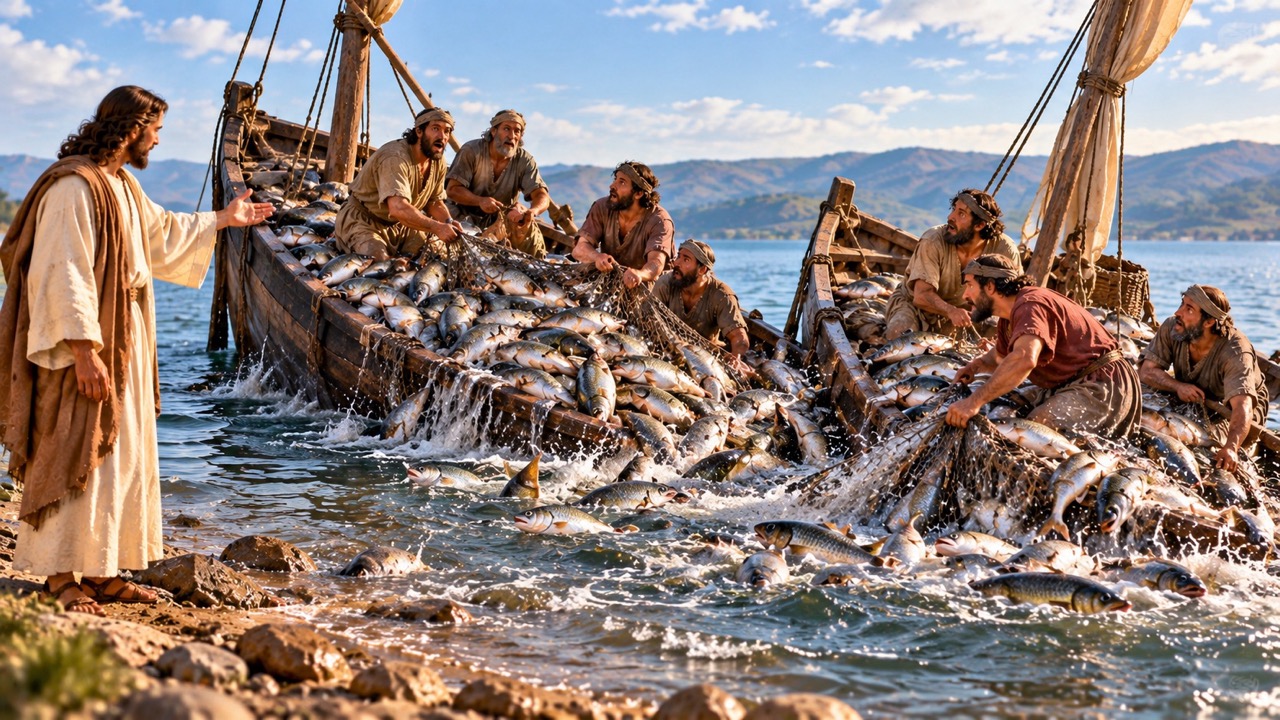
And he saith unto them, Follow me, and I will make you fishers of men. And they straightway left their nets, and followed him.
— Matthew 4:19–20
Two ledgers
In the earthly economy, net worth is tallied in tangible assets: real estate, bank balances, material investments. These are things that depreciate, rust, or fade with time — much as Jesus warned a few chapters later, in words that read like a notice from the only bank that never fails.
Lay not up for yourselves treasures upon earth, where moth and rust doth corrupt, and where thieves break through and steal: but lay up for yourselves treasures in heaven, where neither moth nor rust doth corrupt, and where thieves do not break through nor steal.
— Matthew 6:19–20
Notice that He does not forbid accumulating. He redirects it. The instruction is not stop saving but change where the account is held, and the reason given is a plain one about security: one vault admits moths, rust and thieves, and the other does not. Then comes the line that explains why He bothered to say any of it.
For where your treasure is, there will your heart be also.
— Matthew 6:21
The ledger you keep is not merely a record of where your money went. It is a map of where your heart has followed it.
What the first ledger holds
- Property and holdings
- Balances and returns
- Titles, awards, standing
- Everything the number counts
Audited to the cent. Closed on the last day.
What the second one holds
- Grace extended
- Burdens shared
- A faith lived out
- The Gospel shared
- Souls brought to Christ
Never audited. Still compounding.
The net they put down
There is a quiet joke in the English of it. Those men had nets — real ones, washed and mended, the working capital of a small fishing business. That was their net worth in the ordinary sense: the tools that caught the fish that fed the family. Jesus asked for those nets to be set down, not because the fish did not matter, but because He had a catch in mind that would still be counted long after the boats had rotted on the shore.
And He was precise about what the new trade was. To be a fisher of men is to reach people with the Gospel and draw them toward salvation — that, and not a vaguer kindness, is the commission He left them with at the end:
Go ye into all the world, and preach the gospel to every creature.
— Mark 16:15
Casting a line into that sea measures wealth in an entirely different currency. The ledger of a life spent investing in others is kept in eternal investments — and the entry that matters most is the one only the Gospel can make.
What the second ledger records
- Grace extended. The pardon you gave that nobody required of you, to somebody who could not pay it back and may never have known what it cost you.
- Burdens shared. The weight you carried on the other end of something that was never yours to carry — the hour on the phone, the drive across town, the meal left on a porch.
- A faith lived out. The honesty, the patience, the forgiving that costs you something — done where people can see it, not to be seen, but because a life is the first thing anyone reads of what you believe. “Let your light so shine before men, that they may see your good works, and glorify your Father which is in heaven” (Matthew 5:16). It is the life that prompts the question; Peter tells us to be ready always to give an answer to every man that asks a reason of the hope that is in us (1 Peter 3:15).
- The Gospel shared, and souls turned toward salvation. This is the entry the other two are for. Not merely that somebody felt encouraged, but that somebody heard — that Christ died for their sins, was buried, and rose again, and that the invitation is open to them. “How shall they believe in him of whom they have not heard? and how shall they hear without a preacher?” (Romans 10:14). You may be told what came of it. You may not. Heaven keeps that record either way, and Jesus says there is joy in the presence of the angels of God over one sinner that repents (Luke 15:10).
Paul kept this ledger openly. Writing to a church he had planted and left, he names his assets by their first names:
For what is our hope, or joy, or crown of rejoicing? Are not even ye in the presence of our Lord Jesus Christ at his coming? For ye are our glory and joy.
— 1 Thessalonians 2:19–20
Why it cannot be audited
In that light, a person’s true net worth becomes immeasurable, because the impact of a single life poured out for others ripples outward without a visible edge. You cannot place a market value on redemption, on comfort, or on the quiet restoration of a spirit. There is no column for the argument that did not happen because somebody chose to be patient, or for the child who grew up steady because one adult kept showing up.
Wall Street deals in finite numbers that can always be audited. The dividends of the spiritual harvest compound forever, leaving behind a richness no earthly bank could ever hope to appraise. Daniel puts the yield in the only units large enough to hold it:
And they that be wise shall shine as the brightness of the firmament; and they that turn many to righteousness as the stars for ever and ever.
— Daniel 12:3
Taking inventory
A statement is worth reading, so here is one worth drawing up. Not to produce guilt — the second ledger has no overdraft — but because an account nobody ever looks at tends to stop being funded.
- Who is on your statement? Name three people whose lives are different because you were in them. If no name comes, that is information, not a verdict.
- What are you funding by habit? Look at a month of your calendar rather than your bank statement. Hours are the deposit; money is only one way of spending them.
- Which net are you holding? Not whether you have one — everybody does — but whether you would be able to set it down if He asked today.
Paul told Timothy to charge the rich in this world “that they do good, that they be rich in good works, ready to distribute, willing to communicate; laying up in store for themselves a good foundation against the time to come” (1 Timothy 6:18–19). Not a warning to the wealthy to feel bad about it. A set of instructions for moving the money from the ledger that closes to the one that does not.
So: what is your net worth? Both answers are true at once, and only one of them will still be on the books in a hundred years.
Where to go from here
- Matthew 4:18–22 — the call at the water, and the nets left behind In the White Field Studios Bible reader
- Matthew 6:19–24 — treasure, the heart that follows it, and two masters In the White Field Studios Bible reader
- 1 Timothy 6:17–19 — what to charge the rich in this world In the White Field Studios Bible reader
- God Owns It All The companion piece: whose the first ledger was all along